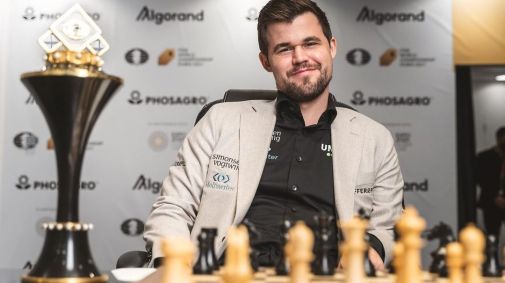
“Is there a sense in which it’s okay to make sub-optimal moves?”, asks a famous podcast host, to the greatest chess player of all time, Magnus Carlsen.
His answer is unequivocal: “You have to, because the best moves have been analyzed to death, mostly.”

The world of competitive chess can give us a lot of insight into what is going to happen with poker in the future. Both games have strong and numerous similarities:
Both are turn-based, zero-sum skill games where success comes from consistent, high quality decisions;
Both games involve pattern recognition to achieve a high level execution;
Both games involve computer programs that can calculate best moves and are studied by all players at a top level – the so-called engines in chess, and the solvers in poker.
Now, hear this incredible fact about chess: the first time a computer program demonstrated super-human performance was in 1997. In that year, IBM’s Deep Blue program managed to defeat no other than Garry Kasparov, considered by many to be one of the greatest chess players of all time (if not the greatest). Kasparov was the world chess champion by 6 consecutive years between the 80’s and 90’s, and during his professional career he ranked as the #1 player in the world for incredible 255 total months. You read that right – that’s more than 21 years (!!!) as the best player in the whole world.
The first time a computer program gained recognition for significantly defeating top level professional poker players in NLHE was in 2017. In that year, an AI program called Libratus defeated top HU NLHE players in a marathon match that lasted 20 days. 4 HU poker pros battled the AI for 120,000 hands, and Libratus came out as the winner, with an incredible 14.7 bb/100 winrate in the sample.

Both events cited above – Deep Blue beating Kasparov, and Libratus beating HU NLHE pros for 14.7 bb/100 – are enormous events. Historic, to say the least.
Now, notice the timespan between them – 20 whole years! The first time a computer program won a game in a competitive chess tournament was in 1967. In contrast, the first commercially available “poker engine” was released in the beginning of 2015, only 10 years ago.
Safe to say we are very, very far behind chess when the context is relationship to technology and the study of optimal play. Even after their release, solvers didn’t become immediately popular in poker, with lots of top players either demonstrating resistance to the new strategies or ignoring their existence. Even to this day, while it’s normal for a chess amateur player to review his game using feedback from a chess engine, amateur poker players will often not even realize the existence of advanced softwares that can tell them the best move.
For this reason – the relative recency of GTO calculators in the day-to-day life of serious poker players – these tools reign as the absolute main method of study and strategy development in poker. For most people, getting better at poker means getting better at GTO execution. A huge portion of the time spent studying equates to effort being made to learn the moves that the poker engines say are the best, then memorizing those moves, and trying to implement them at the poker tables.

Chess has already gone through this phase. They have had their era where learning theory and the best moves dictated by the engine were the main forms of study. But after professionals spent a huge amount of energy in this direction – after they analyzed to death the best moves from the engine, as Magnus says – a new era of strategy development in chess emerged. Here is what Magnus has to say about it:
“Now, I feel like the playing field is a lot more level. There are both computer engines, neural networks, and hybrid engines available to practically anybody. So it’s much harder to find ideas now that actually like give you an advantage with the white pieces. I mean, people don’t expect to find those ideas anymore. Now it’s all about finding ideas that are missed by the engines, either they’re missed entirely, or they’re missed at low depth. And using them to gain some advantage in the sense that you have more knowledge. […] So, short answer is these days, it’s all about surprising your opponent and taking it into position where you have more knowledge”
This is powerful shit.
There is a day in the future where the exact same thing is going to happen to poker. There is a day in the future where top level pros won’t spend time learning the GTO plays anymore, at least not as they are presented by traditional solver algorithms. This day will come because, eventually, humans will reach a point where they have analyzed GTO lines to death. And when this day comes, the focus of high level players won’t be in studying the exact solver output, but rather building their own custom game trees, where they intentionally deviate from the solver solution to funnel the opponents into a line where they feel their edge can be superior to the line recommended by the solver.
If you ask me, “will this day come soon, Saulo?”, my most honest answer is clearly no. Humans are still pretty bad at playing close to GTO, and therefore we still have a long way to go before we can say that we have analyzed GTO to death. On top of that, the speed with which humans improve is much slower than you’d think.
Very recently I recorded a video for my cash game community, Cash Made Simple, where I compared the stats of Midstakes online cash game regulars between 2022 and 2024/25. My goal was to get an idea for how fast the player pool was improving by taking a look at how much the stats had changed during this period.

The result was very clear – yes, the player pool was improving. Pretty much all stats had gotten better – people are defending more against bets, getting closer to GTO thresholds; people are raising more vs bets across all streets, which is a great proxy for high level play (finding the appropriate amount of raises in various spots is the most difficult thing in NLHE); and people are also using more overbets and blocking bets postflop, which are both very characteristic bet sizings of GTO behavior.
That being said, almost all of the changes were very very small, something like 1-3% differences in any given stat. Some stats even changed by less than 1% – like river check-raises in small pots OOP. In 2022 regs were only check-raising 6.4% of the time on the river in small pots. In 2024/2025, this number increased to 7.1%. A 0.7% increase in a period of almost 3 years.
The GTO level for this stat is 12%. This means that currently the gap between midstakes regulars and GTO in this spot is 4.9%. If regulars continue improving 0.7% every 2 years, then it will take the average reg 14 years (!!) to close this gap and reach GTO execution.
Seeing what happened to chess, and seeing how far behind we are in terms of the utilization of technology to learn optimal moves, I would say that something along these lines feels reasonable to estimate when we are going to get to a situation where GTO has been analyzed to death – something between 10 and 20 years.
Now, while this may make you feel like “eh, we have time then, don’t we?”, I want you to take a moment to reflect on the opposite question. Yes, you still have time before we enter this next revolution. We probably have at least 10 years before humans get significantly close to solver performance to the point where it no longer makes sense to heavily study the standard solver output and GTO lines. That being said, what you have to consider is: how much ahead of your competition will you be if you start preparing yourself 10 years before them? How much better than them can you become? And what does that mean for your results?
Simply imagine that for a moment.
You don’t have to be a genius to realize that you’ll enjoy an incredible amount of edge. There is no industry in this entire world where a 10 year advantage won’t simply put you at the very, very top of your market.
The same will happen to poker.
The people who prepare earlier for this next revolution will collect the biggest rewards. Mark my words and send me screenshots of this newsletter in 2035, or 2040, or whenever the time comes. You will wish you had listened to me in 2025, if you are still playing poker seriously by then. The question here is not whether this will happen, but simply when it will happen.
Now you may say: “okay Saulo, I believe you, but how do I get started with this? It sounds weird, and confusing and difficult. I have no idea how to start”. I got you. Or rather, Magnus has got you. Listen to another thing he said in that same interview (he even uses poker terms, wtf):
“It’s also good to know that usually these are not complete bluffs, these are like semi bluffs. So that you know even if your opponent makes all the right moves, you can still make a draw.“
Magnus is talking about going off-tree (I kinda coined this term, and I like it) in a smart, secure way. In poker terms, this is the equivalent of picking a suboptimal line that is very close to the optimal line in EV. By doing this you guarantee that even if your opponent plays perfectly against your strategy, he won’t be able to extract significant EV out of it, because the strategy is close to the optimal one in performance.
I have explored several of these ideas and recorded videos about them to my Cash Made Simple community. For example, I explored how you can introduce an off-tree approach to your SB RFI strategy. Instead of opening to a standard 3x raise size – which every decent reg knows how to react against – you could choose a 4x size, which in theory performs pretty much just as well as a 3x size (negligible difference, and depending on the rake structure, even better in EV). On top of being close to the standard 3x size in EV, the 4x size forces more mistakes in the population response, with most regs failing to 3bet enough, which allows you to significantly expand your RFI range:

I’m betting big on going off-tree. So much so that I’ve started incorporating many unorthodox lines into my strategy. Some are very unorthodox. Take a look at the hand below, where I limped AA from the BTN and managed to stack my opponent in a limped pot:

I’m very confident in navigating unknown areas of the game. To be honest I haven’t even studied much these unorthodox lines – which should be the correct approach when going off-tree, so that you can be better prepared than your opponents. The thing is – all modesty aside – I’m already better prepared than most people, because I can understand theory and population behavior in a deep, interconnected way.
In this hand, despite never studying this spot postflop in-depth, I knew intuitively that my hand was supposed to be a high frequency check on the flop and just a call on the turn.

Now, faced with a river check, I could use my understanding of theory and population behavior to find a thin value bet that induced the overbluff.
In spots like this on the river, when the OOP player bets the turn and checks the river, population displays a major leak relative to GTO: they don’t check enough nutted hands. Humans suck at following the #1 Pillar of GTO Strategy: slowplaying top of range, and this systematic mistake in range construction leads to all kinds of problems in their strategy, most notably a huge overfold and underraise facing a bet. Lacking the proper amount of nutted hands in their checking ranges, humans significantly overfold river facing bets in these B-X lines, and they also massively under check-raise (remember the 7.1% XR of regulars vs 12% from GTO?).
A capped checking range allows you to reopen thinner for value. Your hand will enjoy higher equity when called, and because villain lacks nuts, he can’t bluff you much with check-raises, further increasing the equity realization and the EV of thin reopens. These hands don’t reopen against a GTO player because getting punished by check-raise bluffs is too costly when they can just check back and realize 100% of their equity. But if they win more often when called and don’t get pushed out of the pot enough of the time, their EV simply skyrockets, and you can reopen a lot more hands.
Considering my image as a very aggressive player, I’m always eager for opportunities to thin value bet my opponents. Since they understand I’m capable of overbluffing any spot, they will always feel happy about calling me off on the river, which greatly increases the EV of my thin value hands. So, when he checked to me on that river, I knew exactly what to do.
In theory, I knew I could only value bet this size with 7x or better. It’s obvious – a 1.5x size is too large to accommodate a one pair hand in a 3 to flush, connected and paired runout. Villain is supposed to have lots of strong hands in his range – remember it’s a limped pot, so he could have all combos of 75o, 72o, 87o, not to mention all the offsuit combos of straights with 96o and 64o. So the bottom of my value bet range for this size has to be trips.
However, I also knew my opponent would likely not slowplay enough, and also likely not thin value bet enough himself, putting a lot of top pairs hands into his checking range, when he should in fact block bet with them by the river.

The combination of a capped checking range with a bluffcatcher heavy checking range (way more 8x in it than it should, because people also don’t block bet enough) quickly allows AA to go from pure check to pure overbet on this river:

So, I did it.
And then, the icing on the cake.
He snap check-jammed over my bet.
I’m pretty sure most people would fold in this spot. AA no spade, paired connected 3-to-flush board, villain goes check-raise all in for a massive size (equivalent to a 3.3x pot bet). The instinct is to fold.
But here comes one of the major, hidden incentives for going off-tree: revealing timing tells.
By the time you start navigating lines your opponents are unfamiliar with, and then you combine that with aggressive plays, 2 things are going to happen:
You’ll force them to think through all decisions – there are no automatic plays anymore, because villain is playing a line he’s never played before;
You’ll induce them to play emotionally rather than rationally – being in an unfamiliar zone facing pressure leads to feelings of insecurity and anxiety, which can completely take over their decision making process.
What timing tells reveal the most is the difficulty of the decision. I have studied timing tells extensively in my career, and I even coded a poker trainer myself only to collect timing tell data. I know what timing tells mean.
A snap action means that villain is more likely to hold a hand that he had an easy decision with. Because he didn’t need time to come up with his play, then hands that would be more difficult decisions and require more deliberate time to arrive at the best play will naturally be less present in his snap-action range.
At the same time, snap actions specifically will be heavier on hands that are more likely to be played by impulse. The more time you take, the more you spend time considering potential outcomes and second guessing your gut, therefore long timing actions will contain way less of impulsively played hands, and those will be mostly played fast.
In a spot like this, what are the easy decision check-jams? Well, you could start by saying nutted hands. In one hand, I agree with you – it’s relatively easy to realize you want to raise big with the nuts facing a river overbet.
That being said, there are 2 elements at play here that drastically reduce the amount of nuts in his range. First, is the tendency we already discussed of humans rarely slowplaying enough with nuts OOP, specially on the river. The 7.1% vs 12% frequencies attest to that.
Second, is the obvious fact that regulars will often take their time with nutted hands on the river. You do it, I do it, every reg does that. You will sit there holding the nuts and then you will tank for a few seconds before putting your chips in. Do we do that 100% of the time? Surely not. But some self-investigation will surely tell that we do it pretty often.
Now, what are the next obvious check-jams in a spot like this, hands that could be quickly perceived as reasonable jams and thus be played fast? Well, here it’s pretty clear as well – the counterfeited 2 pairs.
Any player who has played and studied poker for a significant amount of time will almost instantly recognize a counterfeited 2 pair on a paired board as an excellent bluff candidate. It completely unblocks villain’s bet/fold range and blocks villain’s nutted hands, making these hands premium bluff candidates in theory. In fact, my opponent showed up with a hand that is a perfectly reasonable bluff in theory:

That being said, he has lots of those hands to choose from. He not only has 52 as potential candidates, but also 85 and 82, with all its offsuit combinations. That’s a lot of combos.
And then lastly, the fact that my opponent snap raises increases the chances of an impulse-based play. It obviously doesn’t guarantee anything, but it does increase the probability that he is in this instance acting out of impulse.
Facing an overbet in an unknown spot against an aggressive opponent, whose range looks a bit capped from checking flop and calling turn, who now wants to all of a sudden claim the pot, all while you hold the nut-blocker bluff. What would you do?
The outcome is inevitable. My opponent jams the bluff, and I think for a few seconds before making the call. I take his entire stack from a limped pot, and he rage jumps out of his chair, while live streaming on twitch (legit happened, check out sp1ros on Twitch – sorry bro).
This hand demonstrates the power of going off-tree. It demonstrates how I’m not just theorizing here – I’m applying these concepts to my own game, right here, right now – a good 10 years before this will actually become a mainstream thing.
This is the type of stuff I will teach you in my Cash Made Simple community. We launched November last year and we’ll soon reopen our doors for enrollment. Since launch, I have published over 270 videos to our library. You read that right – 270 videos in 11 months. 90 videos on fish exploits, 90 videos on theory heuristics, and 90 videos on reg exploits/off-tree navigation. When I envisioned this product, I wanted to create the best video training platform in the world. And I believe I achieved this goal.
When I reopen for enrollment, it will be for a short period of time, just like at launch – only a 7-10-day window to get the membership and have me as your mentor. Do you want to end like this guy, who will hear great things about it in Vegas but won’t be able to get in because it’s closed?

If you don’t, then sign up to the community waitlist by clicking the link below. By signing up to this list, I’ll make sure to contact you when the community reopens for enrollment, so that you don’t miss the opportunity.
Thanks for reading my friend. I’ll see you next week. Same day, same time. More poker knowledge.
In the meantime – don’t play the game. Play the Metagame.
Saulo