
Poker theory can be intimidating. Equilibrium seems very complex at first glance. But after you finish reading this post, everything will be a lot more clear to you, and you will feel a lot more confident in how to approach balanced strategies.
In a recent post for my Instagram, I said that the main reason poker players are still super exploitable in poker (even though solvers have been around for 10 years) is that everyone lacks method.
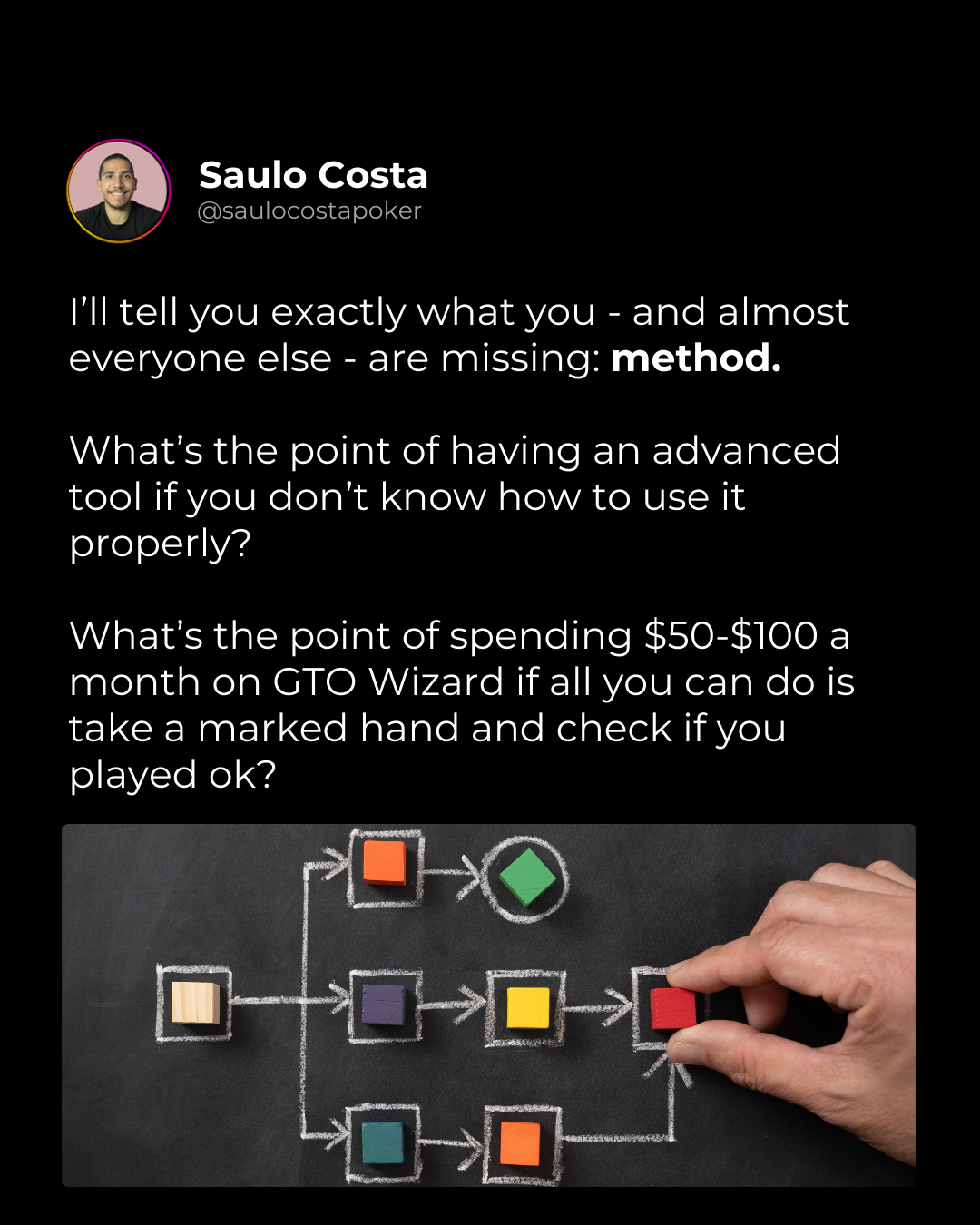
Method in this context refers to how you fundamentally approach learning and executing GTO strategies. What are the steps you take in the direction of getting better and learning what you want to learn.
I know exactly how you approach learning GTO. This is what you do:
The main form of study you like is watching videos. So you’ll watch poker strategy videos on YouTube, or GTO Wizard, or Run It Once, or Upswing Poker.
When you play a hand you are not sure of, you go into GTO Wizard, look up the exact spot that you played and check action by action to see how well or poorly you have played. That’s 60-80% of your “study” of GTO.
40-20% of the time you spend simply browsing sims, not necessarily of hands you played, but just random spots you were curious about or that you decided you wanted to study.
If you are a bit nerdier, you will spend maybe 10-20% of your study time on some drills, practicing the execution of a flop cbet range, turn cbet range or defending vs flop cbets.
End of method.
This is just not good enough. By following these methods, which are the methods that 90% of your opponents are using, you will get the results that 90% of players get: they improve slowly and have super marginal winrates.
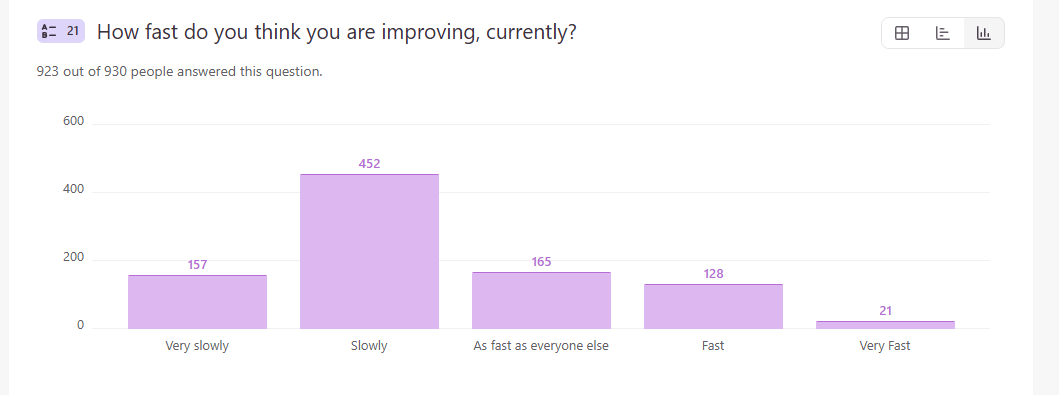
I’m not just throwing subjective perceptions at you. I have surveyed my audience about how fast they thought they were improving and out of the almost 1000 respondents, 66% answered with slowly or very slowly.
And when it comes to winrates, recent research I’ve made shows that the average regular at 500nl on GG Poker makes -1.7 bb/100 of winrate. After accounting for rakeback, this is about 1-1.5 bb/100 of winrate. We are talking midstakes professionals here.
All of this, in my opinion, are direct consequences of lack of method. People make little money because they are not good enough, and they are not good enough because they are improving way too slowly. And they are improving way too slowly because they lack efficient methods.
To be fair with you and cut you some slack now, I don’t think this is your fault. It’s pretty hard to invent a method by yourself, to go against what everyone else seems to be doing, especially when you don’t hear many people complaining about it or showing something better. You are stuck with these poor methods because no one has ever showed you something superior, something you could reliably utilize and generate better results.
Luckily for you, this day has come.
MY FRAMEWORK FOR LEARNING AND EXECUTING GTO STRATEGIES
My method for learning and executing GTO strategies is actually better expressed as a framework. From the dictionary, a framework is “a basic structure underlying a system, concept or text”.
I believe learning and executing solver strategies is dependent on the structure you are using, the elements of this structure, and the methods you utilize to build these elements. My framework for GTO looks like this:
1) Mode of Thinking
2) Mode of Learning
3) Mode of Executing
You cannot learn something if you can’t properly think about it. So Mode of Thinking is the first step in my framework for GTO strategies. Once you have a proper mode of thinking, you can develop your mode of learning, which will involve the actual methods you utilize to learn what you need to learn. In this step, however, a huge progress has already been made, because the structure of what you need to learn has already been partially addressed by your mode of thinking. This is going to become very clear in a moment.
Then lastly, learning in poker is not sufficient. One thing is to learn a good strategy, to be able to tell your friends or even your mom what a good strategy looks like. A completely different thing is to execute what you learned at the tables, with consistency and accuracy. This challenge creates the necessity for a Mode of Executing, a combination of methods that you will create to guarantee proper execution of the concepts and strategies you have learned on step 2.
If you can develop these 3 Modes – Thinking, Learning and Executing – then you will belong to the top 1% of regs that can actually understand and apply theory at the tables.
MODE OF THINKING
Equilibrium is a soup of numbers. It’s this 13×13 grid with 2-4 different colors, where each box in this grid has 2-4 numbers attached to it and you are supposed to take that information and replicate in your game.
The nature of the game mitigates this problem a little bit, since we perceive the game from the perspective of the fundamental value/bluffs dichotomy. This dichotomy facilitates navigating poker strategy, as we can put labels to different hands and assign meaning to the solver’s actions based on these labels. This dichotomy is also perfectly visual and tangible, so thinking about the game in these terms is super easy.
Once we start getting deeper into solver strategy, we obviously fall into the problem of the value/bluff dichotomy becoming insufficient to explain everything. While super useful for the description of river strategies in polarized range scenarios, the value/bluff dichotomy fails to absorb all the complexity of the game the minute we leave simple river toy games. We need more concepts.
Once again, the very nature of the game helps us out. We don’t just have value or bluffs, we have different hand classes in our range of hands. At this level, 2 particular hand classes stand out as becoming relevant to our mode of thinking – draws and bluffcatchers.
Bluffcatchers are not bluffs, as they are better than bluffs, but they are also not value, as they can’t get worse hands to call their bets. These hands are typically static in nature – they start medium value and will very likely end as medium value. Draws on the other hand are volatile creatures – they have the potential to become strong value, but might as well just fail and become garbage.
This is the mode of thinking that most players have. Their range is composed of value bets, bluffs, bluffcatchers and draws. Each of these categories of hands have specific purposes, and our job is to allocate these hands in the appropriate ranges. Their particular properties make them more suitable for this or that action, and the relationship between these categories dictates how we are going to organize them in our ranges.
With this post, I want to offer you a new Mode of Thinking, based on what I believe to be a very useful analogy. This analogy will help you remember what is it that you are trying to do when you are applying theory to your game, and it’s going to make it easier for you to develop a Mode of Learning and Mode of Executing.
THE BEST METAPHOR FOR GTO RANGE CONSTRUCTION
Constructing GTO ranges is very similar to baking a cake.
Yes, I said it.

Wait, I’ll get there.
The act of baking a cake is composed of 3 major elements:
1) The ingredients
2) The amounts
3) The procedures
To bake a cake you need flour, eggs, milk, sugar, amongst other ingredients. Some of the ingredients are optional, others are mandatory. If you miss mandatory ingredients, your cake may never bake. And if it does, it will look and taste like crap. So you must know exactly which ingredients you will need for your cake.
But just knowing which ingredients you need is not everything, you need to know how much of each ingredient you actually need to bake your cake. Proportions matter here, and if you make a big mistake in the amounts, you’ll fuck up your cake. It might still be edible, but it won’t taste very good. One small bite and the disappointment will be immediate.
But knowing the amounts is also not enough. You need to know what to do with these fucking ingredients. Do you put them on a blender, mix it up, then shove it in the microwave? Of course not. You know that this is stupid because you know that baking a cake requires specific procedures. There is a sequence of actions you must take, a combination of steps, and if these steps are correctly executed, and you have all the necessary ingredients, and all the amounts are correct, you will end up with a very tasty cake. Yummy.
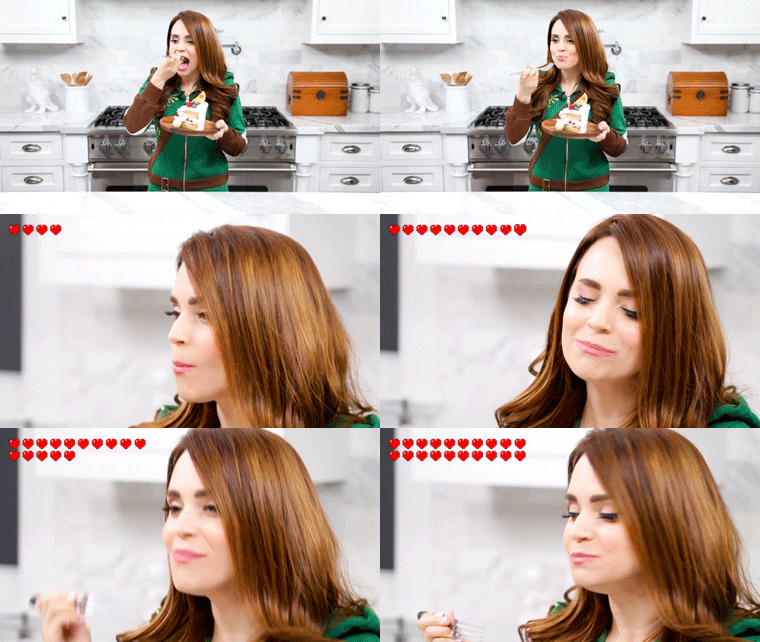
The interesting thing about cakes is that, if you vary the ingredients, vary the amounts of these ingredients, and add some optionals to the recipe – but keep the procedures – you will end up with an almost infinite possibilities of different cakes. All perfectly reasonable and tasty.
Same with poker.
BAKING YOUR POKER CAKES
Equilibrium strategies are remarkably analogous to baking cakes.
Your hand classes are your ingredients. Any reasonable poker strategy requires different ingredients. It’s always exploitable to have only 1 hand class in your range, just like you can’t bake a cake with only 1 ingredient. Just like baking a cake has a list of required ingredients – flour, eggs and sugar, typically – building a balanced poker range will require at least 2 hand classes – value bets and bluffs. In most scenarios, you will have several hand classes, and these will be the ingredients of your balanced range.
The number of combos of each of these hand classes in your range are the amounts of your poker cake recipe. If you want to be balanced, you need to construct your ranges in a way that you get to every spot with the correct amount of combos of each hand class. Building a strategy where your range gets to a certain node with an excess of nuts, or excess of bluffs, or excess of bluffcatchers is exploitable. Your poker cake won’t taste very good. Playing good, balanced poker means constructing your strategies in a way that guarantees appropriate amounts in every spot. Which leads to the final element…
You can only guarantee the construction of a properly balanced range if you execute the necessary actions that make the amounts appropriate. The same way that to make a perfect cake you need to bake it in the oven for a specific amount of time, for you to have a perfectly balanced range you will specific procedures for each of your hand classes.
The combination of an action/frequency pair will guarantee that your cake has the appropriate amount of ingredients in every spot. Bet your nuts too much and your checking range is exploitable. Check your bluffs too much and your betting range is exploitable. Each hand class has a procedure, which consists of saying what that hand class needs to do, and how often it needs to do it.
If you can combine the right ingredients (hand classes) with the proper amounts (number of combos) and follow the correct procedures for each ingredient (the action/frequency pair), you will have a perfect poker cake. A truly balanced range that no one can exploit.
THE UNIVERSAL PROCEDURES IN POKER
Now we finally get to the title of this post. The email you clicked had the title “The 5 Pillars of GTO Strategy”.
The Pillars of GTO Strategy are the 5 procedures that must (almost) always be executed for a balanced range to exist. I call them Pillars because I like the visual image it conveys, and how the meaning relates to its purpose.
A Pillar is something strong. Something that serves as the fundamental support of a bigger structure. Big structures will pretty much always need pillars.
Just like to make a cake you always need to bake it in the oven, there are some procedures in poker strategy that you must always execute to guarantee that your range comes out balanced. Without these procedures, your poker cake will not be tasty. It will be imbalanced.
In this sense, the pillars of GTO provide support for the existence of balanced strategies. If you want to get good at poker theory, you must master the use of these pillars.
PILLAR #1 – SLOWPLAYING TOP OF RANGE
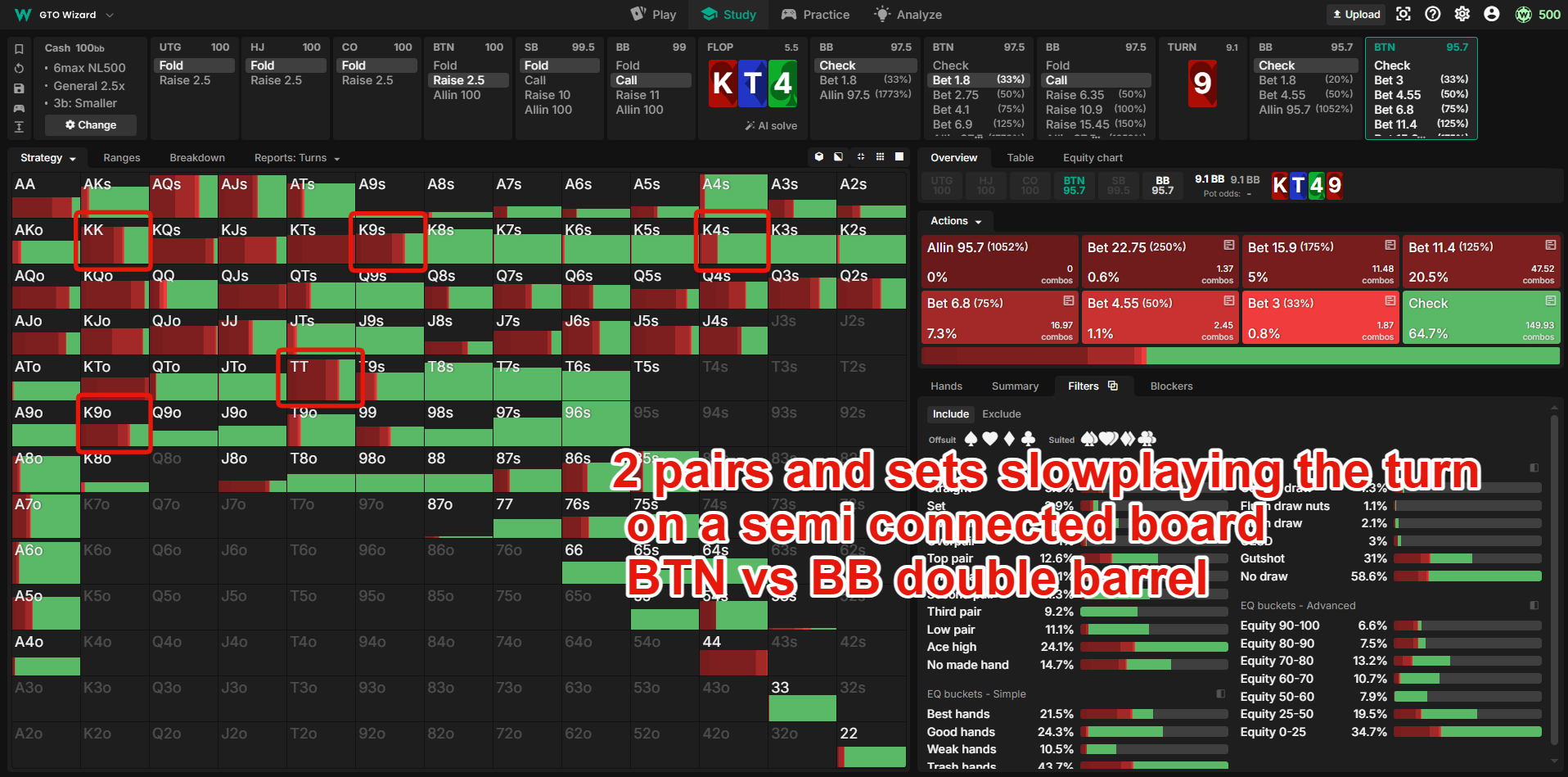
The 1st Pillar of GTO Strategy is the procedure of (sometimes) slowplaying the top of your range. This is a necessary procedure to guarantee balance.
Every single solver sim you look at, in virtually any node (except when on the river in position) you will see very strong hands getting slowplayed at some frequency. This is a necessary condition to guarantee balance across your multiple strategic options. Not slowplaying the top of your range makes one action contain too many strong hands, while the other actions will contain too few. The lack of this procedure causes an imbalance in the amounts of your ingredients, ultimately causing the whole cake to taste bad.
Almost every player violates this procedure, and this is a major cause of exploitability in human poker strategy.
PILLAR #2 – MIXING IT UP WITH THE DRAWS
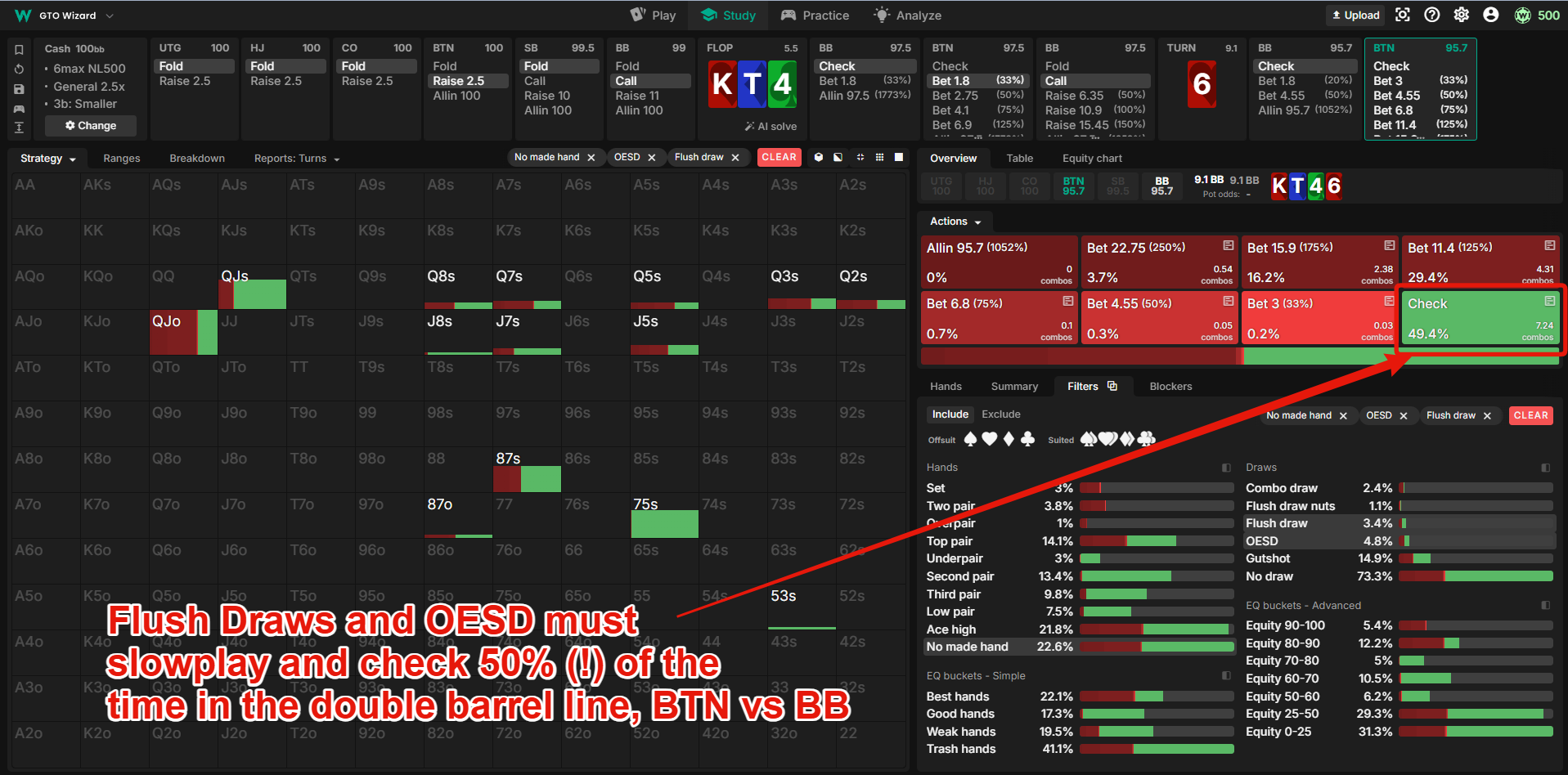
The 2nd Pillar of GTO Strategy is the procedure of (almost always) being unpredictable with your draws. There is virtually no situation in poker where it’s correct to play all of your draws in only one specific way.
As you might imagine by doing some self-investigation and self-evaluation, this pillar gets violated all the time. Humans love fastplaying draws. We call them natural bluffs, right? It’s just natural to fastplay.
But violating this pillar also introduces major vulnerabilities to your strategy. Your betting ranges become way too equity driven, against which your opponents should overfold their marginal bluffcatchers.
At the same time, your checking ranges will be super exploitable when you check and the draw completes. Suddenly you have no nutted hands, and your opponent is completely uncapped. He can murder you with aggression and there is nothing you will be able to do about it.
PILLAR #3 – BARREL COMPLETE AIR AND LOW PAIRS
Uuuh, this one is basically non-existent in most player’s strategies.
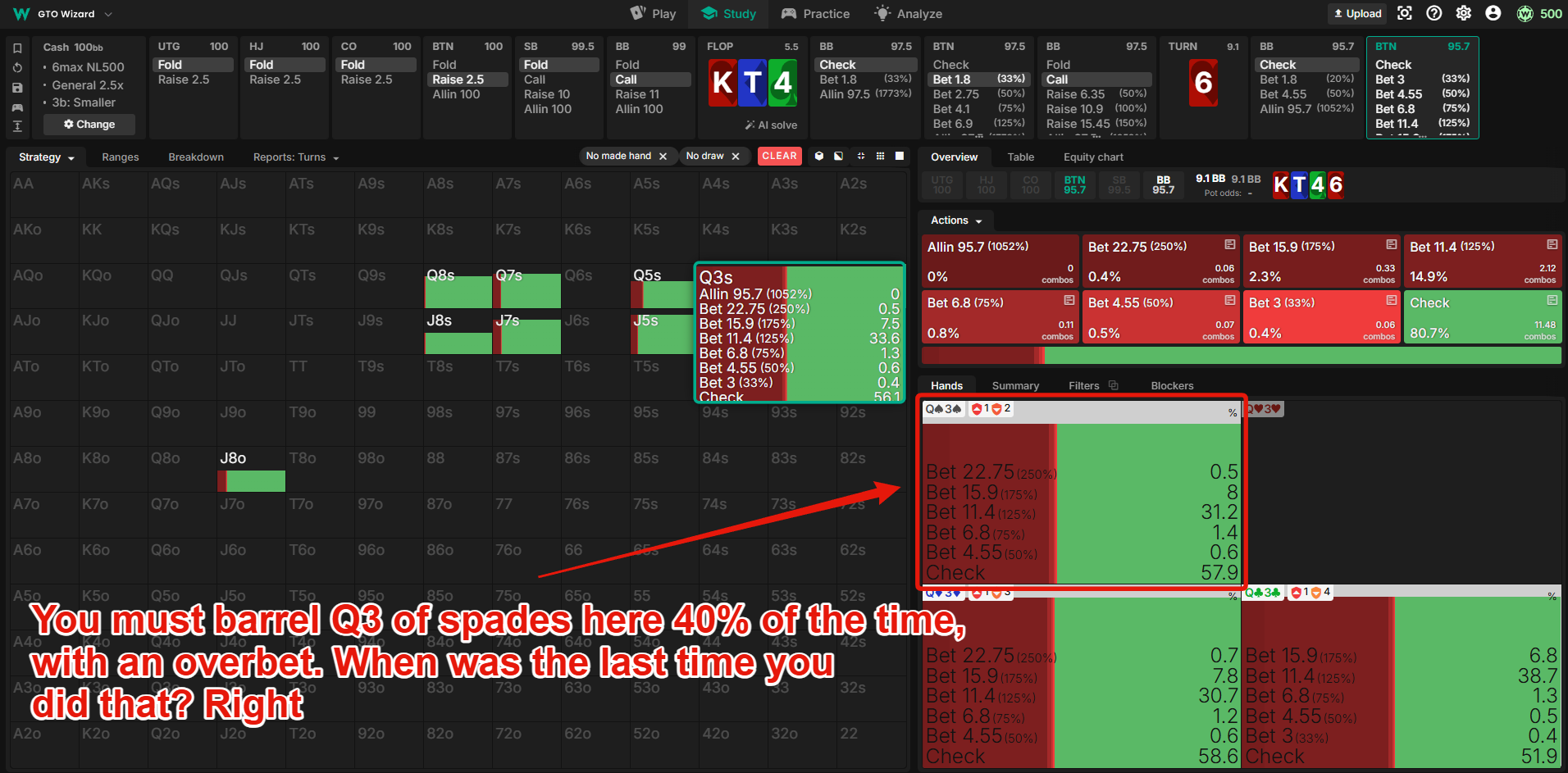
This pillar consists of the procedure of allocating at least some complete garbage, air hands (and sometimes low pairs) to your betting/raising ranges.
You can’t be balanced in poker if all the bluffs you have all the time are draws, the so called natural bluffs you love to fastplay. Doing so leads to a problem I’m 100% sure you have already suffered yourself and exploited in someone’s strategy, which is the decision to overfold with your bluffcatchers when facing a bet on a draw completing runout.
The flushdraw hits, the straight completes, and all you’re thinking is “huh, he doesn’t have any bluffs now. Everything completed. I’ll just fold”. You think you are doing the right thing, and in fact against population you probably are, as this 3rd pillar is non existent to most people. But the same way you do it to others, they are doing it to you. When the draws complete, your value bets don’t get paid because people know you are imbalanced. By properly observing this pillar, you will be able to start extracting bluff EV from the situations where people overfold but you do actually have bluffs.
CONCLUSION
The remaining pillars I will leave for you to find out in my GTO Blueprint course. After covering the 5 Pillars, the course provides you with Universal Heuristics. If I must slowplay the top of my range, at least sometimes, in almost every spot, how do I decide which hands to do it with? The Universal Heuristics module answers this question (and many other range construction questions) by providing you with patterns of range construction that repeat themselves throughout the entire game tree. By learning these heuristics, you immediately get better at multiple parts of the game.
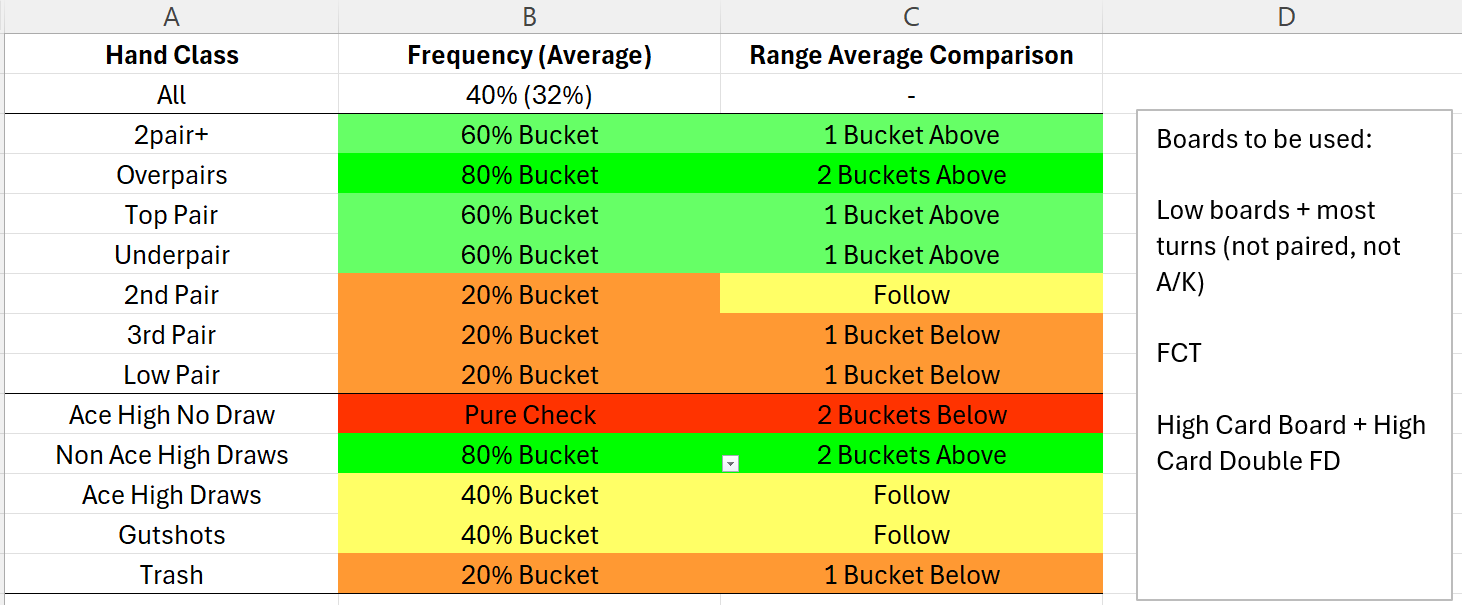
Okay, but after you learn that you should slowplay the top of your range (universal procedure, pillar of GTO), and you learn which hands to do it with (hand selection, Universal Heuristics), you need to learn how often to do it in all spots. That’s what the How to Play Postflop modules cover: a complete strategy blueprint for every single hand class in your range, for every important line, in every postflop spot of the game. Like this one, for the turn probe line BB vs BTN:
If you want to learn more about the course, click here.
The baking-a-cake analogy is very powerful for visualizing what you want to achieve and what you need to do to get there, in the context of balanced strategies. By using this mode of thinking, you will achieve much higher clarity on what’s the purpose of each ingredient in your strategy, allowing you to get better at learning the patterns and executing them in game.
In my next post, I will go over the 2 Remaining Modes you need to master to become really good at this game – The Mode of Learning and The Mode of Executing. I hope you will open your inbox next Monday, by 10 AM UTC, to learn more about them.

Thanks for reading my friend. See you next week.
In the meantime – don’t play the game. Play the Metagame.
Saulo