

$10,000 per month sure sounds like a nice income, right? In fact, last week I sent out a survey for the readers of this newsletter, and the most frequent answer to “how much money would you like to make per month?” was exactly $10k.
$10k a month equals $120k a year.
I never even dreamed of something like that when I first started in this game. My long term goal when I quit university to pursue poker full time was to be a 3 bb/100 winner at 100zoom. Crazy to think about it now, but at the time that was the maximum I could envision, simply because I didn’t have many good references for what was achievable in this market.
The truth is that you can make a lot more than 10k/month in poker – if you become really, really good. Top online High Stakes professionals, both in cash and MTTs, make something between 500k to 1M per year.
That being said, they belong to a very small minority. The majority of poker professionals are in fact making less than 100k a year. So, to break this down and develop a plan for how to get there, we need to understand exactly what it takes in terms of parameters to achieve this type of income. So let’s do some math.
THE 10K/MONTH MATH
For this math here, we are going to focus on online cash games as the primary activity generating income. It’s obviously possible to achieve the same with MTTs, with very similar math – swap volume in hands by volume in amount of tournaments, swap winrate for ROI and stakes for the average buy-in.
In cash games, your profit can be calculated as follows:
PROFIT = VOLUME (hands) X WINRATE (bb /100) X STAKES (big blind size)
From this formula, we can see that 3 variables will determine our profit:
The amount of hands we play per month
The winrate we have at the tables (post-rakeback)
The stakes we play
This is important to realize because once you understand you can pull each of these levers, or any combination of them to achieve your goal, then you will understand that there are multiple ways to get to $10k/month with poker. Ones more likely than others, but still, multiple ways.
The first variable we need to talk about is the stakes. Being very objective here, the minimum stake where making 10k/month is possible in online poker is at 200nl.
100,000 x 5 bb/100 x 2 = $10,000
If you play 100,000 hands per month at 200nl with a 5 bb/100 winrate, then you will get to exactly $10k/month in income.
Before you say anything, I said possible, not probable. In fact, having this kind of winrate with such a high volume in 2025 is extremely difficult. It used to be a lot easier when stars and bodog zoom games were amazing (I had almost 6 bb/100 of winrate in those games for millions of hands), but those pools have dried up in the last few years. So to achieve this kind of profit at 200nl in 2025 you will need to, put it simply, to be a sicko. If you can consistently make 5 bb/100 (post-rakeback) at 200nl while grinding 100k hands a month, you should simply be playing much higher and making a lot more money.
A similar, but yet more extreme scenario where making 10k/month at 200nl would be possible would be by doubling the volume in a high rakeback site. If you grind 200k hands/month with a 2.5 bb/100 winrate post-rakeback, you will make 10k in profit.
This type of volume is crazy high. At 750 hands/hour (4 tabling zoom), it would require 267h of playing per month, the equivalent of roughly 9 hours a day, every single day.
While likely not sustainable in the long run, it’s definitely possible to do this for a period in your life. In 2020 I had a student who did just that. He actually played even more – he played 250k hands/month at the party poker 200 fast forward tables, and finished that year with over $200,000 in profits. That student years later became my partner, and today he is the CEO of my staking business Metagame. One of the sickest work ethics I have ever seen.
Now, what we discussed thus far is just extremely unlikely. Both scenarios – 5bb winrate with 100k hands/month and 2.5bb winrate with 200k hands/month – are just not realistic at all for 99% of individuals. Therefore, we have to up the stakes.
THE REALISTIC SCENARIO
The first stake where 100k/year actually becomes realistic is at 500nl. In fact, back in the golden era of 500 zoom games, multiple 6 figures were possible at these stakes. If you had a 5 bb/100 winrate and played 70k hands a month (totally achievable volume at 750 hands per hour, which means less than 100 hours of grinding per month), you would make $17,500 per month, or $210,000/year. I’ve witnessed someone do just that and it was the reason I played so much zoom in my life.
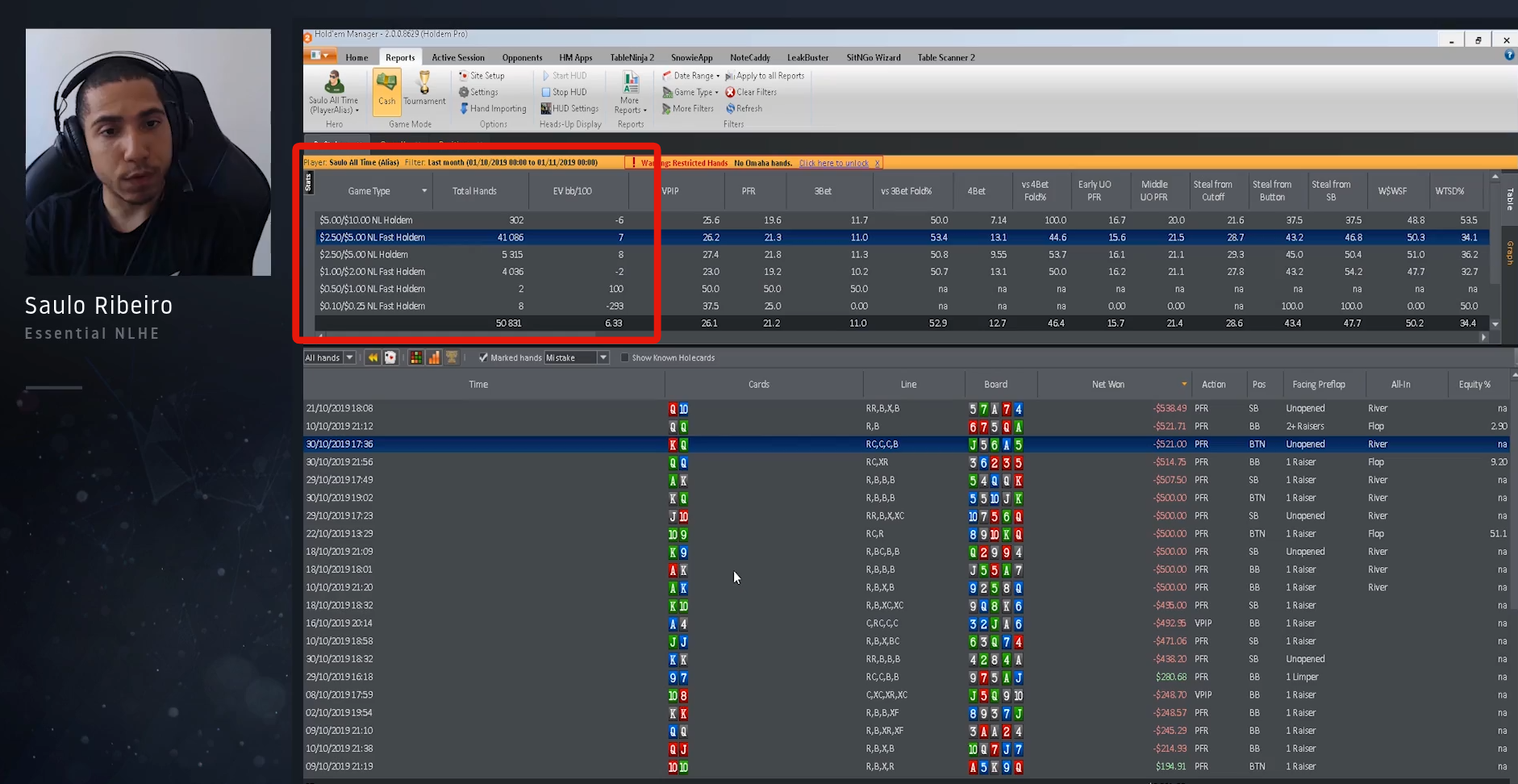
I never really achieved 5 bb/100 in that game, but the 3.5 bb/100 winrate I had in my entire sample allowed me to make 10k/month many times grinding 500z. The very first month that I grinded 500z as my main stake I made around $16,000. I recorded a video for Run It Once at the time and showed my results and some hands to the viewers:
So what does it take to realistically make 10k/month at 500nl in 2025?
Considering that there are no zoom games for this stake anymore, in any site (the maximum sites have these days is 200nl zoom/zone/rush&cash/blitz), then the following realistic parameters can get you to 10k/month:
Volume = 50k hands
Winrate = 4 bb/100 (post-rakeback)
50,000 x 4 bb/100 x 5 = $10,000
50k hands per month at regular tables is perfectly achievable, without all that much effort. If you play 6 tables at a time, and each table deals 75 hands per hour, then you will be playing 450 hands/hour. 50k hands then would require 111 hours of grinding. If you only work during work days (therefore 20 days/month), you would need to play 5.55 hours per day to achieve this volume. 2 hours of studying per day, half an hour for breaks, 5.5h of grinding – in my opinion, the perfect daily routine for a professional.
Then, we have the 4 bb/100 of winrate.
Remember, we are talking about 4 bb/100 post rakeback. In some sites, like GG Poker, getting this kind of winrate pre-rakeback is almost impossible, but when you account for rakeback then it becomes very achievable. If you play 50k hands of 500nl on the site, your rakeback will amount to more than 3 bb/100, which means you would only need to be slightly profitable pre-rakeback to achieve your goal.
In other sites, where the rake isn’t so insane like GG Poker, then a pre-rakeback winrate of 4 big blinds is absolutely realistic. Sites like Bodog/Ignition, WPT Global and even Coin Poker. If you sign up to these sites using my affiliate links, part of your rake turns into coins that you can exchange for my products and services. Essentially some rakeback in form of coaching. If you have any doubts, just reply to this email and I can explain how it works. If a certain site doesn’t appear for you in the link above, it’s because it’s not allowed in the country you are located.
Now, let me give you some tips so that you can maximize your chance of getting that 4 bb/100 post-rakeback winrate.
GAME SELECTION
You won’t get to 4 bb/100 of winrate if you keep playing in bad games. Very roughly speaking, if you are playing a table and the fish at the table is playing less than 40% VPIP, then the chances you are making 4 bb/100 in that table are very very low. The rake will have to be super low and the fish on your direct right for you to make something close to 4 bb/100 on that table. In those circumstances, it’s better to look for another table, where your winrate can be higher.
Remember that poker is a zero sum game, but with the significant problem of high rake. If there isn’t a huge loser at the table, then it simply gets impossible to make a decent winrate, simply because rake eats everything. If rake is 6 bb/100 per player, then 36 bb/100 hands are leaving the table and going to the site. Someone needs to lose this much only for the other players to break even. If you want to make 4 bb/100, then you either need to extract disproportionally more money from the fish than the other players at the table (by sitting at their direct left, for example) or the fish needs to lose an incredible amount like 50 bb/100. I shouldn’t need to tell you this, but if the “fish” at your table is playing 32 VPIP without making huge punts every now and then, then guess what: you ain’t making 4 bb/100.
Very important to emphasize something at this point, which is often neglected even by professional players: each table has its own winrate and hourly. Your winrate isn’t this magical number that is static and stable across all sites and tables that you play. It’s actually simply the weighted average of the winrates of every table you ever played. Once you understand that, you will realize how much money you have left at the tables for not caring more about game selection. Playing a bad table is not just lowering your winrate, but is also increasing your variance and wasting your time and energy, which you could be spending to make a lot more money on a better table/game. If you want to get to those sweet $10k/month, do not neglect game selection.
LEARN FISH EXPLOITS
I run the risk of getting repetitive when talking about this, but it’s so important that I’ll do it anyway.
Crushing the fish is the lowest hanging fruit available in online poker. Your winrate comes from these players, and they are extremely exploitable. That being said, most low and midstakes players don’t know how to properly (max) exploit the fish. This is a huge leak.
You need to imagine that you are a business and the fish are your customers. Your revenue and profit come from these customers. What does a business owner do to maximize revenue and profits? He studies his customer behaviour and then builds products and services that maximize the lifetime value of that customer. You should do the same.
When was the last time you spent multiple hours in a week towards the study of fish behaviour? Unfortunately, I know that a huge percentage of readers here would have to answer never if they were being honest. It’s just not part of most people’s study routines (when they have one to begin with) to study recreational player behaviour and exploits.
You would be surprised at the number of crazy exploits you can pull off against fish if you know what you are doing. You could be doing stuff like this, calling down underpairs in 4bet pots against Raise-Bet-Bet and printing (hand from a student of mine in my Cash Made Simple community):
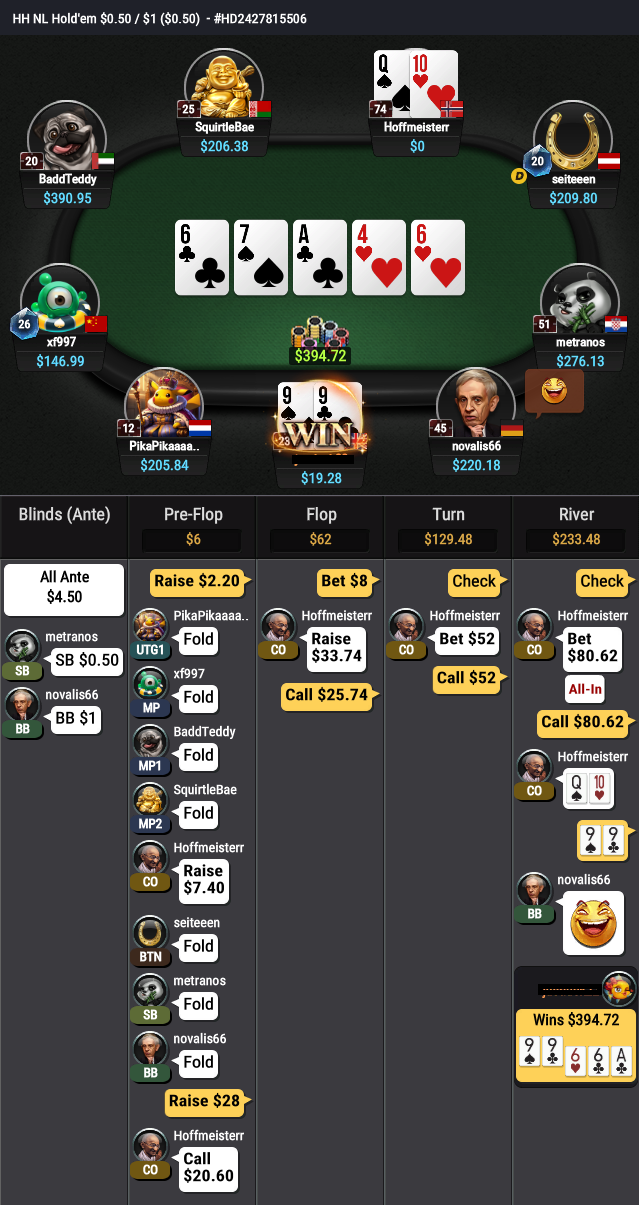
Sounds crazy at a first glance right? But when you study fish behavior, plays like this become a very simple and obvious execution.
Recreational players have 39% bluffs in this line on average, with a 30% pot betsize. The potis over 100 big blinds by the river, and they are overbluffing by an insane 20% margin. In a circumstance like this, clicking the call button nets you incredible 37 big blinds. 37 big blinds of profit in one single action against them. To put things in perspective, if you have a 4 bb/100 hands winrate, you need to play almost 1000 hands to make this kind of money. 1000 hands of profit in one single call.
If this doesn’t motivate you to study fish behaviour, then I don’t know what will.
CRUSH THE BOTTOM
If you want to get to 4 bb/100 winrate and make $10,000 a month consistently playing 500nl, then after proper game selection and learning fish exploits, you need to learn how to extract the most out of the weaker regulars in your player pool.
Poker is a game where only relative skill matters. You don’t need to be a genius, you just have to be better than (some) other players at your table. And right after the fish (with all of their subprofiles), the most exploitable players are the weak regs.
I’m talking about the nits. The very passive, risk averse regulars. Perhaps you belong to this group at the moment, and before exploiting these players, you need to stop being one yourself.
It’s ok if you are a nit at the moment. Lots of players are. In fact, at midstakes, around 30% of regulars belong to a group you could call nits – very low aggression frequencies, very low bluffcatching frequencies and in general very face-up, ABC range constructions. The type of player who never puts you in a tough spot, and defaults to a non resistance behaviour under pressure.
If you play 6-max cash games and you are not a nit yourself, then statistically it’s almost guaranteed that you will have a nit at your table. There are 4 reg seats left after you and the fish, and if you are a not a nit and nits are 30% of the player pool, then it’s very likely that at least one of the 4 remaining regs is a nit.
That reg should be your target. The size of the edge you can have against him is multiple times higher than what you can achieve vs the other regs at the table. If you want to maximize your chances of getting to that 4 bb/100 winrate, you need to squeeze as much value as you possibly can from those players.
Let me emphasize the last few points to you in a way that can drive the point home: I’ve built a multi-million dollar poker business out of, primarily, exploiting fish and weak regs. That’s what I’ve been doing for the last 6 years, and in this period my students have won over $10,000,000 at the tables.
Poker is war, and if you want to get out of it victorious, you need to understand that the money you make comes from these guys’ pockets. Will you passively wait for them to punt and put the money on your hands, or will you actively reach for their pockets and take all that you can? Notice how this simple mindset shift can change things significantly for you. If you are not currently going into your sessions with a predator mindset, you are not playing poker correctly.
Weak regs are extremely exploitable. And perhaps the only thing you are currently doing to exploit them is to overfold when they show aggression. That’s cool and correct, however it’s just a Level 1 type of exploit. Everyone can do Level 1 exploits.
If you have been an avid reader of this newsletter, you know what I’m talking about. Beneath the obvious first level, there are 3 other levels waiting for you to use them and make a lot more money in the process.
Weak regulars are passive, so while their betting ranges are strong and you should overfold vs aggression, notice how any imbalance introduced in a given node generates an imbalance in all the adjacent actions. That’s the definition of a Level 2 exploit.
You are probably very familiar with the idea that weak regulars overfold to aggression. It’s not necessarily a secret. And one of the main reasons they have this leak is that their checking ranges are too weak. It’s the only way to have a strong betting range after all, right? If they are strong when they bet, it means they are not betting enough of their bluffs. Those bluffs are going somewhere – their checking ranges.
The fact that they underbluff when they bet and overfold against bets leads to countless exploitative opportunities. If they underbluff when they bet, not only their range composition is stronger, but also their betting frequency is lower than it should. If your opponent barrels less often than he should, he is immediately allowing you to overrealize your equity, because you will see the next card more often.
Extra equity realization leads to range expansion.
I remember when I was at lowstakes studying Run It Once videos, I once saw a video where a coach was constructing BB defense ranges against an open by using the equities of their hands + an equity realization estimation to reach the proper range that could be defended. This was prior to the preflop solver era, hence why this had to be done this (apparently rudimentary) way.
You shouldn’t defend the same range preflop against a weak reg and an average reg. You shouldn’t defend the same range vs a cbet on the same board, if the reg is weak, compared to what you would do vs a better player. This type of player will check the turn more often, will fold more to turn XR, will overfold to river probes, river check-raises, will lack thin value bets in the BXB line, won’t bet big enough on turns and rivers.
All these leaks lead to incredibly higher equity realization, and such higher equity realization leads to range expansion. You should call more often vs cbets, bluff them much more often every time they check, and even overcall them preflop to take advantage of these exploits.
I have specialized in these complex exploitative models for years. Combining my experience as a poker player and my background as a software developer, I can create programs that simulate real players’ leaks and model their behaviors on PioSOLVER to come up with the best exploitative response.
For instance, this is what you should do against flop cbet BB vs BTN on K73r if your opponent is a nit:
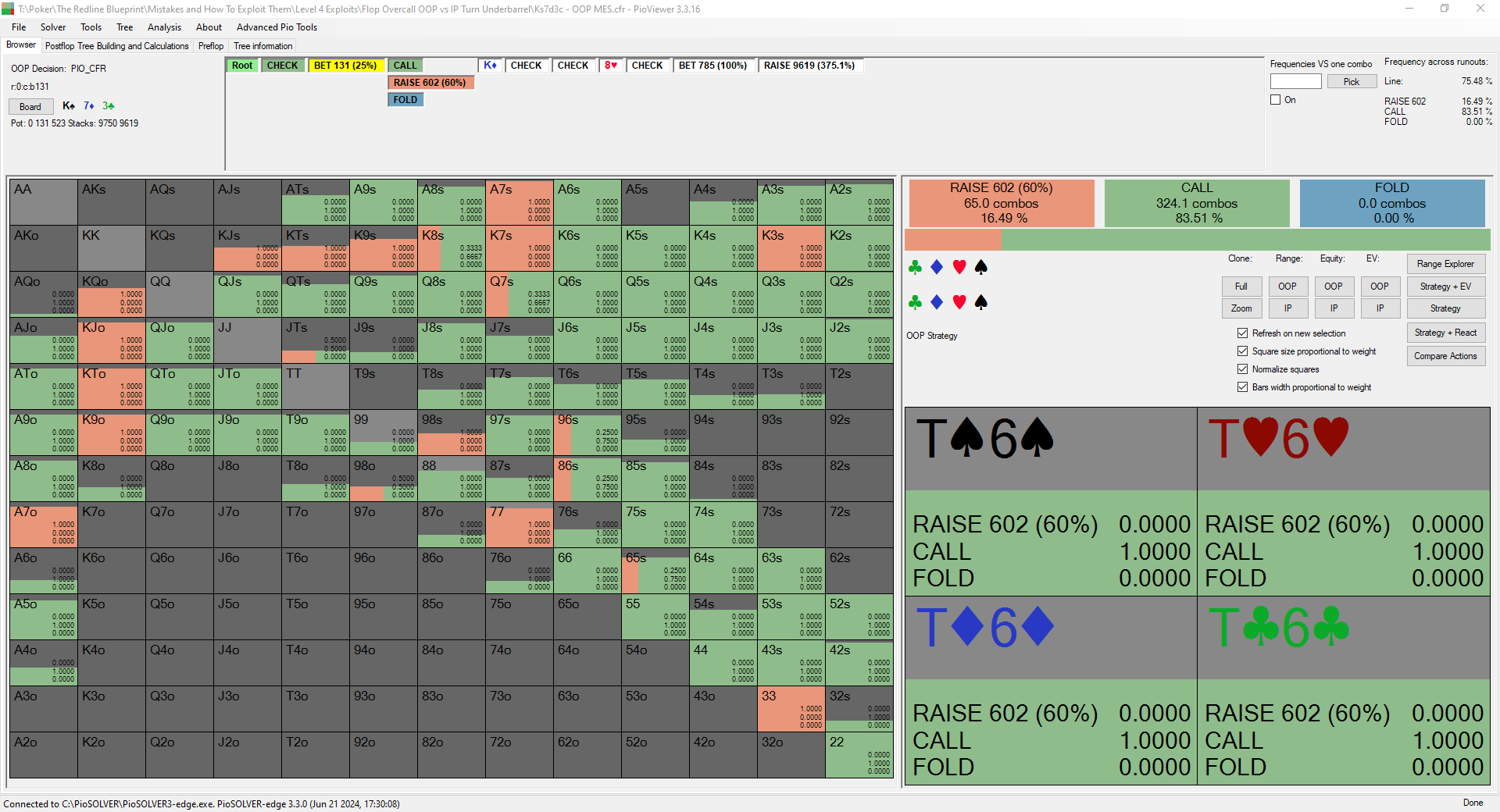
This tree was created by nodelocking a nit opponent that under barrels the turn by 5% after cbetting flop. They under barrel 5% because they check their airs a little too much. Hands like completely naked Q highs, J highs and T highs with no equity, that solvers barrels at a low frequency (10 to 30% at times).
This leak (with all else equal) incentivizes you to fastplay your value on the flop, because the opponent won’t barrel enough to justify mixing some slowplays like GTO does. And this leaks generates a massive river overfold vs probe when they check back, because their checking range contains more air than it should. This extra EV you can generate in the river probe line, combined with the fact that you are already seeing the river 5% more often than you should, allows you to make any 2 cards a profitable call on the flop. This is a Level 4 exploit: you adjust early street strategy as a consequence of your opponent’s leak. You anticipate his mistake and adjust early to make the most out of it.
This is the type of thing you should be doing to the weakest players. You should be crushing the bottom.
I’ve just opened up 5 spots to my CFP program and 2 spots to my private coaching program. This is an opportunity to get trained directly by me, where I will be able to help you achieve your so wanted $10k/month income. If you are interested, click the link below and fill the form:
Thanks for reading my friend. I see you next week.
In the meantime – don’t play the game. Play the Metagame.
Saulo