
In our last post we talked about my framework for learning and implementing GTO strategies.
The framework looks like this:
1) Mode of Thinking
2) Mode of Learning
3) Mode of Execution
Last week we covered Mode of Thinking.
I gave you a very useful analogy for navigating and constructing GTO ranges: baking a cake.
Playing solid theoretical poker and baking a perfect, tasty cake, are remarkably similar activities.
To bake a cake you need:
1) Ingredients, like flour and eggs
2) Correct amounts for the ingredients
3) Procedures, like bake it in the oven for 40 minutes at 200 degrees
That’s exactly what you also need in poker. You need ingredients – hand classes; you need them to be in proper amounts in your ranges – number of combos; and you need the correct procedures to construct a proper range, like “bet your top pairs 60% of the time and check 40%“.
With this mode of thinking, it gets much clearer what exactly you are trying to accomplish when constructing your strategy. You just need to take the right ingredients, ensure that you have the proper amounts of them, and execute the procedures that each of them asks for, in order to build the perfect range.
Following this analogy, I gave you a few universal procedures that are absolutely essential to guarantee a balanced strategy. I call these universal procedures Pillars of GTO Strategy.
A pillar is something strong, that gives support to a bigger structure. That’s what the Pillars of GTO do – they guarantee that your balanced structure isn’t going to collapse. You can only guarantee the strength of your strategy structure by following the procedures from these pillars.
I gave you 3 procedures for you to start using in your game:
1) Slowplay top of range
2) Mix it up with the draws
3) Barrel air and low pairs
You can’t be balanced without these procedures. For a balanced range to exist, you must execute these procedures, otherwise you’ll become exploitable.
MODE OF LEARNING AND MODE OF EXECUTING
Now, while these universal procedures are absolutely essential to be executed from a global perspective, what you actually execute in game is something more specific.
Poker is a very simple game, in the sense that your execution at the tables only requires 2 parameters: your betsizing and your frequency.
That’s it, there is nothing else to it. To play high level, GTO Poker, all you gotta know is how much to bet (or raise) with any given hand, and how often to do it (to guarantee the correct proportions of the ingredients in your poker recipe).
Therefore, it follows that, for every spot and every hand class, we need to come up with a specific procedure, one that includes – for that particular line, hand class and board texture – how much you will bet, and how often.
These procedures can look something like this: “On Double broadway 2 tone flops BTN vs BB, I’ll bet my flushdraws 80% of the time with the 120% pot sizing”.
This is a procedure that is following the principle from the 2nd Pillar of GTO – Mix it up with the draws.
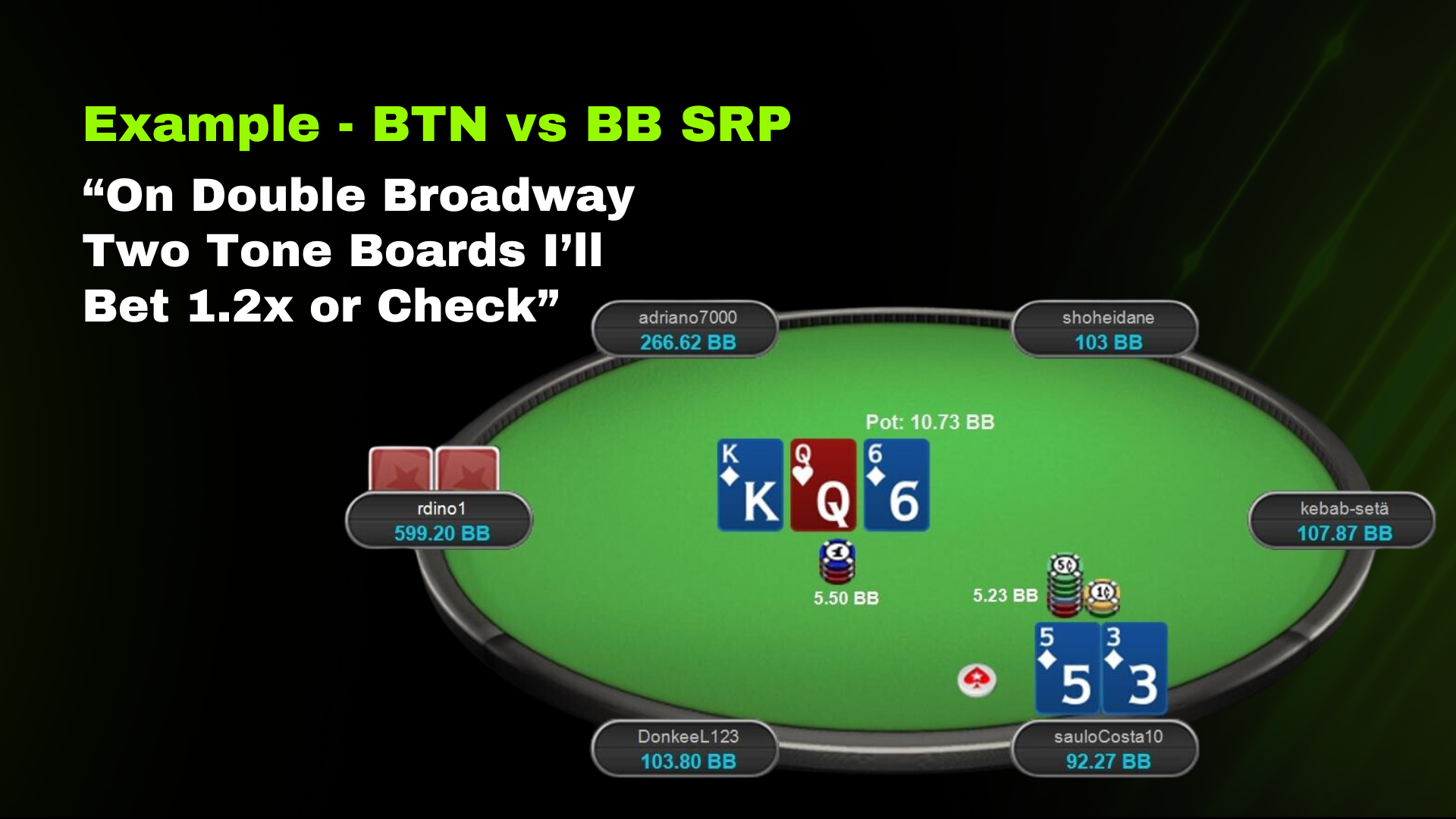
This type of procedure in poker is often referred to as a heuristic.
A heuristic is a simple solution to a complex problem. Playing poker is complex, and you can’t solve boards in your head during game. So you must prepare for the in-game situations off the tables. Given that your execution is about picking a bet sizing and a frequency for a given hand on a given board, those are exactly the parameters that your heuristics must contain – how much to bet, and how often to bet, in every line and every board texture.
If this sounds like too much, I can say: well, it depends.
Surely, doing this for every unique hand imaginable in every board imaginable is of course impossible. There are too many possible combinations for a human brain to be able to process.
However, the very nature of the game facilitates this process a bit for us. While we may have dozens or even hundreds of different unique hands in our ranges at all times, lots of these combinations are essentially the same in practice. On a KQ6 board, it doesn’t really matter whether you have 6c5c or 6s5s. These are pretty much the same hand. It also doesn’t matter much whether you have K9 or K8 or K7. All of those are top pairs with a medium kicker, and they will be played pretty much exactly the same.
Same can be said about board runouts. If the board is KQ6 with 2 diamonds and the turn comes the 4 of clubs, that’s pretty much the same as the turn coming the 5c. The difference in strategy execution is absolutely negligible, which helps us decrease the scope of our strategy development.
Your job as a poker player is to develop as many heuristics as you possibly can, for as many spots of the game as you can.
Your heuristics are your knowledge base. They represent the gameplan you have to ensure your strategy is sound and reasonable in the majority of possible spots. Remember, you can’t solve boards in your head in-game. You need to prepare off the tables, as much as possible. Yes, surely there will still be situations where you’ll be forced to simply think through the best decision in game using your brain power (as even with clustering you likely can’t prepare for everything), however the more you reduce the amount of decisions you need to make using your capacity to solve spots in real-time, the less mistakes you are going to make, because obviously your on-the-fly strategy generation will be imperfect and flawed.
With this established, we can then start talking about the most important concept about Mode of Learning in high level poker. If you want to get really good at this game, then your Mode of Learning needs to be one that optimizes for heuristic generation. In other words, the methods you use for studying poker need to be effective methods for the purpose of building accurate strategy heuristics. The measure of how good your study methods are is proportional to their capacity of outputting ready-to-use strategy heuristics for the varied in-game situations.
Because of this statement, you can immediately realize how your current methods are flawed and ineffective. In our last post we briefly talked about this. Your current methods are: watching poker videos, checking your hands against a GTO sim, discussing hands with your friends on Discord, and then occasionally doing some drills.
Out of these methods, the only one that effectively promotes heuristic building is Drilling. All of the other methods are trash study methods. Yes, I said it.
Now, what I say comes from my personal perspective of this game. I’m sure many successful people in poker will have different opinions, and I’m totally ok with that. But you have subscribed to this newsletter to hear what I think about poker, so here is what I believe you should be doing instead of watching videos and browsing GTO Wizard:
Run (or purchase) GTO Hand Histories
Import Hand Histories to H2N
Develop your own set of hand classes and board textures you want to group and study
Build bet sizing heuristics for the different board textures using H2N filters
Extract hand class frequency heuristics for the most important hand types using H2N filters
Compile that into GTO Sheets
Build flashcards for each useful heuristic
Study those flashcards everyday
This is in my opinion the best study routine and Mode of Learning for someone trying to acquire more poker theory knowledge that is applicable at the tables. You need to know how much to bet, and how often to bet, for every hand class, in most lines of the most important spots in the game, and you get to know that by building your heuristics using GTO Hand Histories + H2N, and then drilling those heuristics using flashcards. The steps and routine above guarantees that you are actually building new heuristics for your game, which is the most important thing, and it also includes a method to effectively memorize these heuristics (flashcards) so that you can correctly recall them in game.
Maybe some of the steps above are a bit foreign to you. Maybe you don’t have much experience (or any at all) with using H2N, or running GTO Hand Histories. If you want to learn more about how exactly to execute these steps to effectively learn poker strategies, then sign up to my GTO Secrets Masterclass. It’s a full 1.5h class where I show you, step-by-step, my above process for heuristic generation. You’ll finish with a ready-to-use system that will greatly increase your speed of learning.

In the GTO Secrets Masterclass I show you them more in-depth, but here is an example of a GTO Sheet that I have compiled for the spot of 3BP IP PFC (3bet pots In Position as Preflop Caller), in the flop stab line (bet vs missed cbet):
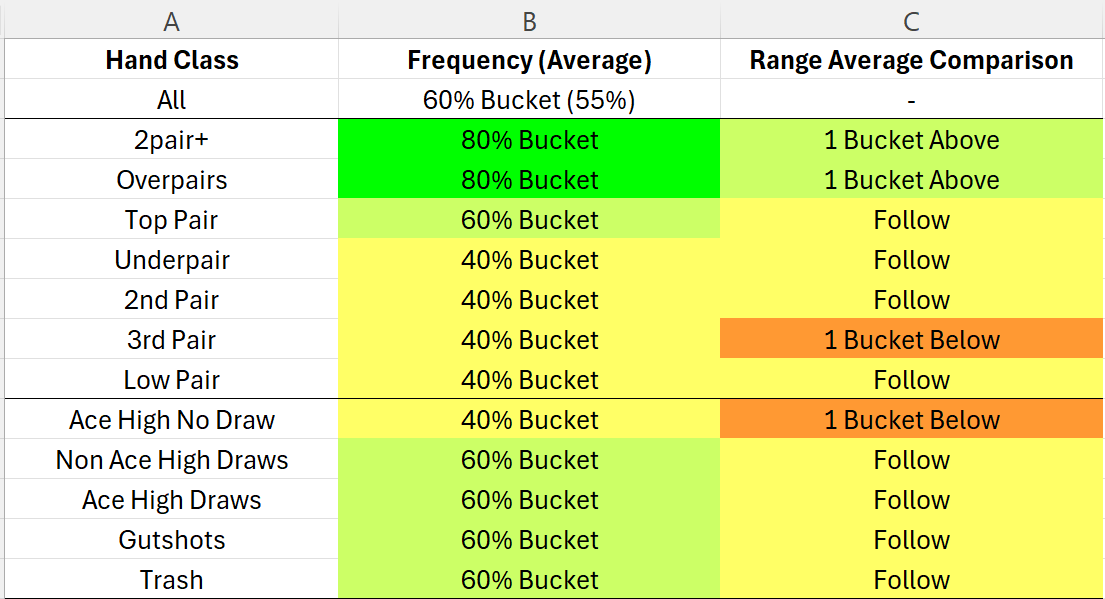
From these Hand Class Heuristics Sheets, I can then write all the necessary flashcards. At the front of the card you write what you want to learn and remember, for instance: “How often should we bet gutshots in the flop stab line, 3BP IP PFC?”. At the back you would write, of course, 60% bucket. You do this for all the hand classes in all of your GTO sheets. This will build you your deck of heuristics.
If you consistently study this deck of cards, reviewing the cards everyday, you’ll become a monster. You’ll have mastered Mode of Learning and will be ready for Mode of Executing.
MODE OF EXECUTING
This mode has already been partially addressed in this post. You can see in the print above that I have specific hand class frequency heuristics, and that they are described in buckets, and these buckets are all multiples of 20% frequency – 20, 40, 60 or 80. These are 2 pillars of my Mode of Execution.
The first one is that I’ll cluster hands of the same category together. Instead of trying to memorize frequencies for every hand in every spot, I compile hand class frequency heuristics. This is a huge gain in applicability, because I go down from literally hundreds of different combinations of hands in my range to effectively only differentiating between 12-15 categories. 12 is something manageable, something that with the right tools can be memorized.
Another pillar of execution is the rounding of mixed strategies. You can see from the print above that my strategy is developed by allocating hand classes to specific frequency buckets. Instead of getting lost into the 100 different possibilities for the frequency of a hand class, I round the strategies to the nearest strategy bucket, allowing me to go from 100 different options to only 6 – pure check, 20%, 40%, 60%, 80% and pure bet. This is another huge gain in execution, because it is often possible to figure out the best strategy by a simple process of elimination of the wrong buckets.
My mode of execution has one major goal: to make a pseudo-GTO strategy actually implementable.
Most people who try to play close to theory fail miserably. On average, theory-oriented players end up playing way tighter than the solver, missing specially river aggression and correct defense frequencies vs aggression. This happens because they weren’t intentional with their acquisition of knowledge, and didn’t employ any measures for reducing the complexity of equilibrium.
By clustering hands into hand class groups and clustering mixed strategies into mixed strategy buckets, you can then go into your sessions with a much easier method for deriving the best play in game. All you gotta do is pick a bucket for your hand class and execute the action according to an RNG. Easy stuff.
I’ve given this framework for my students in 2022, where they played 1M hands against GTO Bots. Their goal was to play as close to solver, using the bucketing system for mixed strategies. The result of their strategy implementation was surprisingly remarkable. They were able to achieve range compositions extremely close to balanced. Take a look at their flop cbet range BTN vs BB compared to GTO:
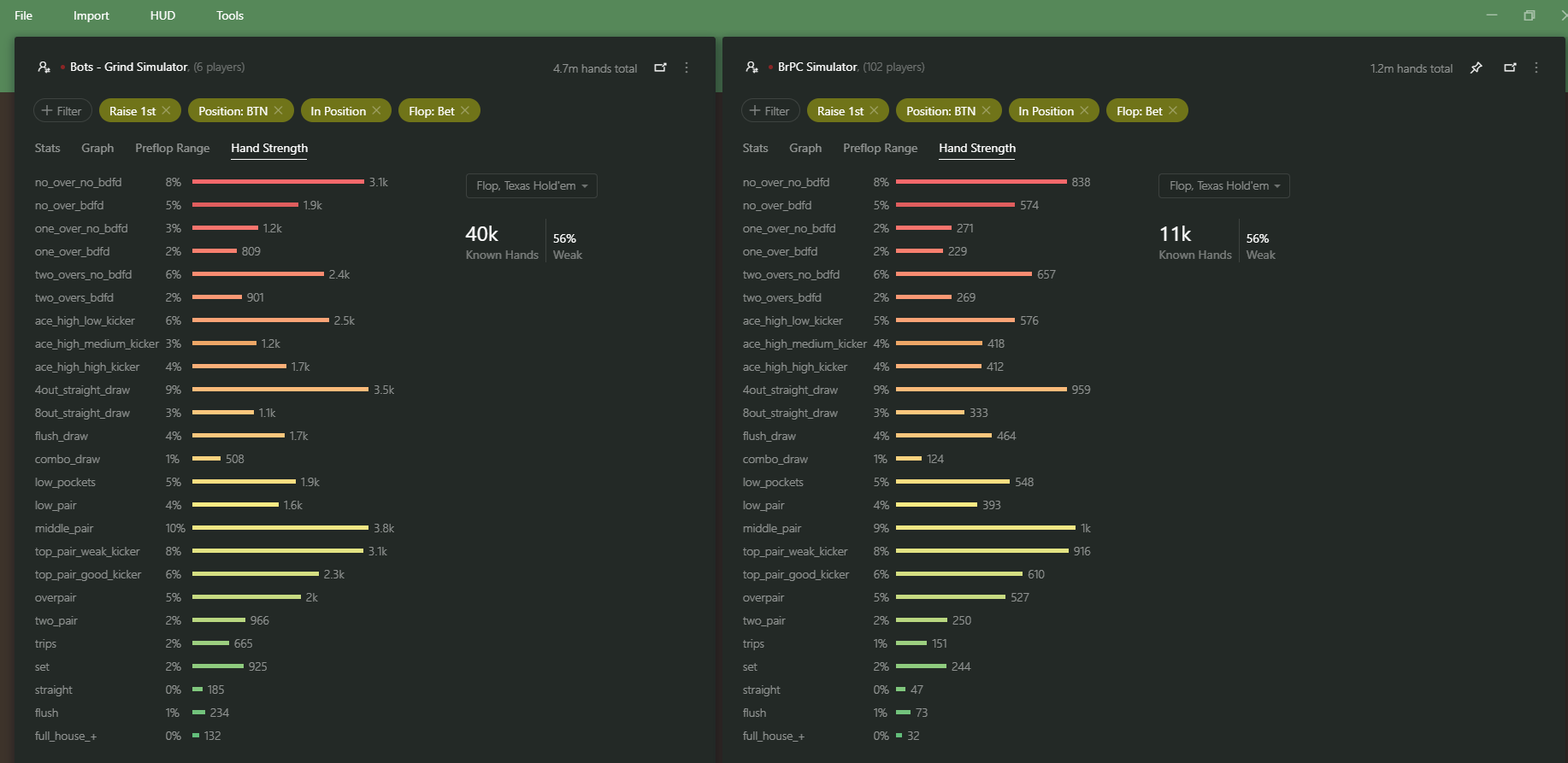
By using this framework, you definitely have good chances of achieving a super low exploitability strategy that no human can significantly exploit. But don’t be fooled – it still takes a lot of work, building the heuristics, studying them and applying at the tables.
SHOULD YOU USE THIS, THOUGH?
Now, my goal with showing you all of this is not for you to get obsessed with a rigid and super theoretical implementation at the tables. Everyone that has followed me for some time knows that I love theory, but I think it has its place in strategy execution. Theory is a tool, not the end goal, and therefore should be used as such.
One of the things I repeat the most in my content and to my students is that knowing the theory makes you a better exploitative player. When you know that in order to be balanced you need to slowplay 20% of your nutted hands in a given spot, but you can sense that your opponents are not doing this, you will be able to use that information to adjust your strategy against them and make more money. When you know that to be balanced you need to bet 60% of complete trash hands vs a check – but you can observe that your opponents are not doing this – you can then immediately derive exploitative adjustments that will increase your winrate. All because you studied the theory.
If you are ready to take the next step in your theory studies, check out my GTO Blueprint course here.
Thanks for reading my friend. I’ll see you next week.
In the meantime – don’t play the game. Play the Metagame.
Saulo