

We’re back! After a long hiatus, I decided to get back at writing my free weekly newsletter.

If you are not sure what’s going on, you’re receiving this email because you interacted with at least one of my offers/events in the past, including this newsletter.
If you don’t want to continue receiving these emails, there is an unsubscribe button at the bottom. I really think you shouldn’t do that though. I wrote 24 articles to my newsletter between end of 2023 and mid of 2024, and people were really enjoying it at the time, take a look:
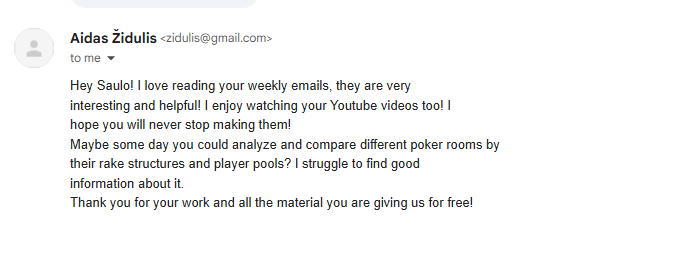
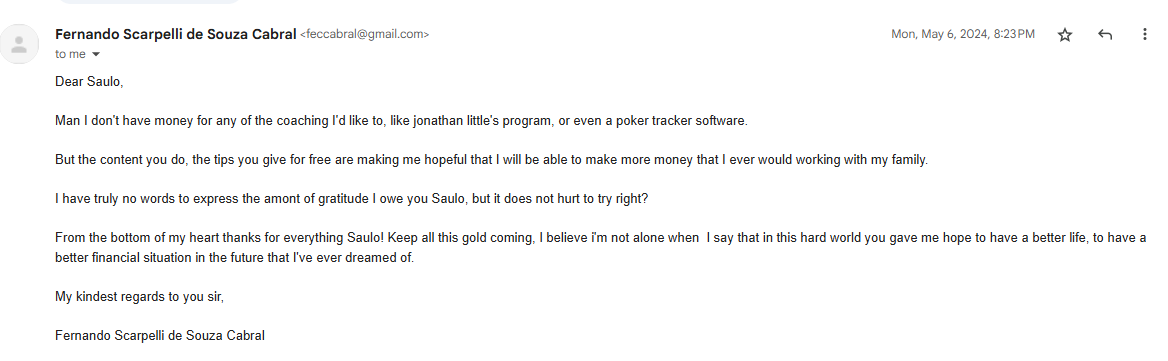


Now I’m getting back at it full force, providing you high level poker content directly to your inbox every week!! Why would you say no to that???
ㅤ
So now I’ll assume you’ll stay subscribed, and that we’ll have this time together every week. The posts come out every Monday, 1PM UTC. They take 5~10 minutes to read, give away lots of knowledge completely for free and you can even suggest topics by replying to this email!
Enough said my friend. You can now make your most informed decision: to unsubscribe and let everyone else take the free value except you, or invest 10 minutes a week into getting better at poker, completely for free, with a material that an experienced coach like me could easily charge for.
Your call.
Now let’s talk about the important stuff: today’s post is about my framework for exploitation, The 4-Levels of Exploits Framework. If you can really internalize and apply this framework into your game, you’ll 10x your return on exploitative strategies. That’s how much money there is at the table here. Let’s dive into it.
THE CONTEXT
Today, you very likely execute some form of exploitative strategy in your game. Pretty much everyone does – and that’s good. No one plays perfectly balanced in poker, which means their strategies are exploitable, one way or another. Therefore, if you can identify how exactly their strategy is exploitable, you’ll be capable of deviating from a theoretically derived strategy to something that exploits the perceived imbalance in your opponent’s game. If you do that successfully, more money will flow towards your pockets.
The most obvious example of an exploit in poker is when someone decides to fold a decent hand against a bet from the opponent with the argument that the opponent “doesn’t have enough bluffs here”. Every single poker player has done that at least once in their lifetime – took a hand that a solver would never fold with, which looks pretty decent or even strong, but that against a weak human opponent is very unlikely to make money with the call. So we throw it in the muck and feel we made the right decision.
This type of exploit is what I call a Level 1 type of exploit. Level 1 exploits include:
Overfolding against an opponent that is underbluffing;
Overcalling against an opponent that is overbluffing;
Betting thinner for value against an opponent who is checking a capped range;
Overchecking against a top heavy checking range;
A Level 1 type of exploit is any exploit that reacts directly to the opponent’s imbalance. This is the simplest form of exploitation possible. Your opponent does something wrong with his action, and you immediately react to it by adapting your own strategy, in the direction that you think became more profitable. If they bluff too much, calling becomes better than folding with all your bluffcatchers – so you call more. If they check a range that is too capped, value betting now became the best option with lots of marginal hands – so you value bet. A Level 1 exploit recognizes an imbalance and reacts to it immediately after, trying to make more money than a GTO strategy would.
I’m sure you can understand this. This is basic stuff for someone that has played poker for some time, especially those with some online poker experience. Everyone knows this.
And that’s exactly the problem – or the opportunity, if you are more optimistic.
THE PROBLEM
99% of poker players stop at the level 1. When poker players think about exploits, that’s what they think about. Identifying an imbalance in the opponent’s action and reacting to it after they take place.
99% of people play the game. I’ll teach you how to play the Metagame.
What happens when everyone has the same idea about something, and everyone has the same knowledge about it? I’ll tell you exactly what happens: the room for actually finding edges is extremely small. You exploit your opponent a little bit here, he exploits you a little bit there. You exploit the fish a little bit here, your fellow regulars exploit the fish a little bit there. Everything is equal. If all you got in your repertoire are Level 1 exploits, you are gonna have to make a tremendous effort to generate edge against your player pool, because everyone has the same tooling as you to work with. If your job is to chop as much wood as possible in the forest, but all your competitors have the same axe as you, you can’t really be proud of your axe. It’s not a competitive advantage at all. What you do with the axe is also extremely simple – you chop wood. Sure, there is some technique involved, but for anyone mildly experienced in chopping wood, the technique used also won’t be a competitive advantage. Everyone knows that you are supposed to fold a mediocre hand against a nit. You’re not doing much better than anyone else by executing that exploitative technique.
Now, what if instead of using an axe to chop wood, you had access to a box of tools that make chopping wood way easier and faster? What if you had a fucking sci-fi laser thingy that you can just point at the tree and it cuts it off in a split second? What if only you had access to this tool, how much ahead of your competitors would you be, when all they got is an axe?
I think you are getting it. The laser thingy exists in poker. There is a repertoire of exploitative adjustments that go way beyond level one exploits, and this repertoire allows you to make much more money against your opponents than simply reacting to their mistakes after they have committed them. There is more in poker than just an axe. Once you learn it you stop just playing the game, and you start playing the Metagame.
LEVEL 2 EXPLOIT – EXPLOITING THE ADJACENT ACTION
The second level of exploitation is one of my favorites. It’s so incredibly obvious, and yet almost no one executes these exploits consistently. Mastering level 2 exploits will make you a much tougher player to play against, and will allow you to see potential for extracting edges everywhere.
The main logic you need to learn to master Level 2 Exploits is the idea that if an action is imbalanced (let’s say, an imbalanced betting range, checking range, raising range, etc), then all the adjacent actions are also imbalanced.
An adjacent action is any action that your opponent could have taken in his last turn:
Checking is adjacent to betting, and vice-versa;
Calling is adjacent to folding and raising, and they are all adjacent to each other;
ㅤ
Let’s go back to the nit underbluffing rivers example. Everyone knows how to exploit a super strong betting range – you just fold. Now, if your opponent is underbluffing, where did their bluffs go?? They need to go somewhere, right? One of the possibilities is that they are giving up too much with the bluffs they got there with. If they are getting to the current street with bluffs but they don’t fire enough of the time with them – making their betting range too strong in composition, then they are automatically making their checking range too weak. If the betting range lacks bluffs, then the checking range very likely has an excess of bluffs. You should exploit that with a super aggressive betting strategy when the nit checks.
Are you following so far?
ㅤ

The example I just gave is the easiest one to understand. But there are a lot more.
Imagine you are playing an opponent that likes to play tricky and slowplay his good hands. He noticed you are aggressive, so he decided he will prepare traps for you at every opportunity. In his mind, he is exploiting your imbalance of being too aggressive. And he might.
But if he is playing tricky with his good hands and slowplaying them all the time, what happens to his betting ranges? I hope you got the point by now. If he is trying to exploit you by slowplaying his strong hands, now all of his betting and raising ranges will be capped. You can exploit the shit out of this opponent by overcalling and playing ultra aggressive when he puts money into the pot. You know he lacks the necessary amount of strong hands to be balanced (because he is slowplaying them), so all of your value hands increase in equity, allowing you to bet larger, bet thinner and to bluff more in consequence. Your bluffcatchers will also enjoy higher realization, as this player will either overbluff when betting (again, because he lacks the top of the range) or will end up allowing you to get to showdown too often – both circumstances increase the EV of your bluffcatchers.
Want one more example? I got you.
Imagine you are playing an opponent that bets too thin for value and doesn’t bluff much when has the initiative. He figures you are a calling station so he wants to guarantee max value whenever he has an at least decent hand. If you call too much, he can indeed get value out of you by playing this way.
However, what happens now to his checking ranges? If he leads thin for value and doesn’t bluff much, then his checking range is garbage. His checking range is filled with air hands and a bunch of weak bluffcatchers. Against this range, you should play aggressively with bluffs and passive with value.
His weak bluffcatchers and air won’t be able to resist against aggression. Your bluffs will get a ton of folds. At the same time, if you check, he will massively overbluff, as his checking range doesn’t contain good hands – so your value will profit from his air. Therefore, the max exploit for you is to bet bluffs and check value.
Level 2 exploits can double the amount of money you make against your opponents. Instead of focusing solely on the target action (the action you perceive to be imbalanced), you need to start thinking about how this imbalance in the target action causes an imbalance in the adjacent actions.
Once you internalize this mode of thinking, a whole new world of exploits opens up at every opportunity. You stop playing the game and you start playing the Metagame.
ㅤ

LEVELS 3 AND 4 – 10X’ing Your Return on Exploits
As I said in the title of this post, The 4-Levels of Exploits framework has the potential to 10X the money you are currently making through exploitative strategies. We already covered how to double it – start exploiting the adjacent actions. Levels 3 and 4 will cover the remaining factor of 5 we need.
I will go easy on you today and leave these 2 levels for a future post. We’re just getting back and I don’t want to overload you with too much information. Now, if you really want me to go over these 2 remaining Levels in the next post, please reply to this email with “Yes Saulo, teach me levels 3 and 4”.
If there is enough interest, I will go super deep on the most profitable levels of exploitation in the whole game of poker. This is stuff I could realistically charge you for, and you would pay me. But I’ll do it for free if you guys show me some appreciation. Hope to see you next week. A new post will drop in your inbox next Monday, 1PM UTC.
In the meantime – don’t play the game. Play the Metagame.
Saulo
